
1C Charge Rate: What It Means for Joinsun NCM Cells
A C-rate tells you how fast a cell fills. Here is what 0.5C, 1C, and 2C mean for charge time, heat, and cycle life.
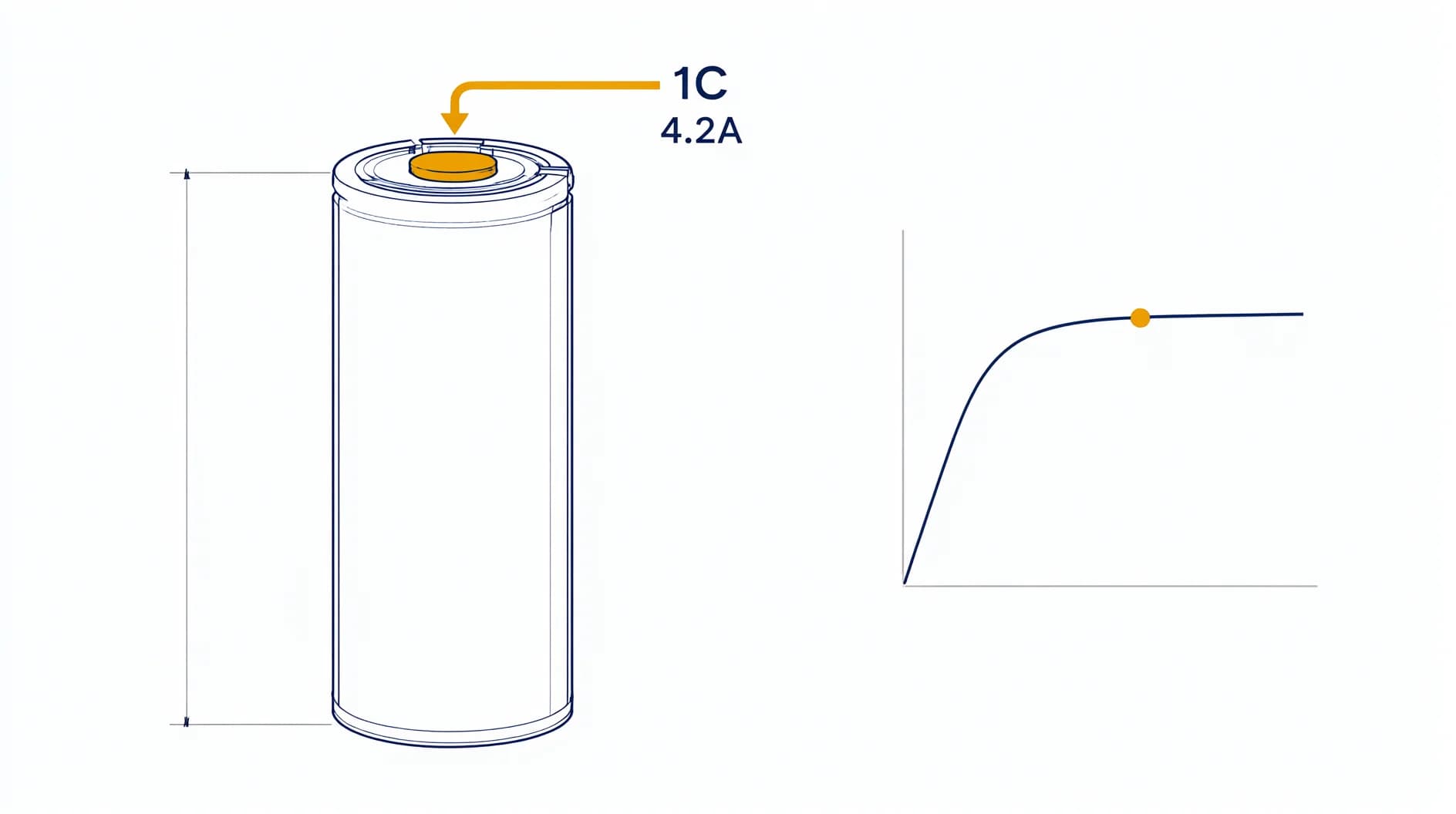
Every Joinsun datasheet states a maximum charging current in amps. That number is also written as a C-rate. The two describe the same limit.
This article explains the C-rate, shows what the rate does to charge time and heat, and lists the charge rate of every cell we sell.
What a C-rate means
The C-rate is the cell's own capacity, expressed as a multiple.
- 0.5C means charge at half the rated capacity in amps.
- 1C means charge at the rated capacity in amps.
- 2C means charge at twice the rated capacity in amps.
To convert a C-rate to amps, divide the rated capacity in milliamp-hours by 1000, then multiply by the rate.
The INR18650-42D is rated at 4200mAh. At 1C that is 4200 ÷ 1000 = 4.2A. The INR21700-60D is rated at 6000mAh. At 1C that is 6A.
The rate is not a preference. It is a limit the manufacturer sets, and the datasheet warranty assumes you stay at or below it.
What the rate does to charge time
A cell charges at a lower current and takes longer. That part is arithmetic.
At 1C, a cell takes roughly one hour to reach its full charge in theory. In practice it takes longer. The last part of the charge slows down on purpose. The charger holds the current until the cell reaches about 4.2V, then holds the voltage steady and tapers the current down to near zero. That tail is where the cell goes from roughly 80% to 100%.
| Rate | Time to roughly 80% | Time to full |
|---|---|---|
| 0.5C | about 1.5 hours | about 2 hours |
| 1C | about 45 minutes | about 1.5 hours |
| 2C | about 25 minutes | about 1 hour |
These are estimates for planning a charge window. The tail length depends on the charger, the cell temperature, and where the charge stops.
Charge current is not state of charge
These are two different things, and buyers often mix them up.
- Charge current is the flow of charge, in amps. The datasheet sets a ceiling for it.
- State of charge, or SOC, is how full the cell is, in percent.
The same 4.2A moves the same amount of charge per hour whether the cell sits at 20% or at 90%. The difference is what happens to the energy. Near the top of the charge the cell voltage is higher, so the same amperage carries more power. The cell also resists current more at both ends of its range than in the middle.
That resistance is what produces heat. Heat follows the square of the current, so doubling the charge rate does more than double the heat. It also starts the cell's life off hotter, every cycle, for the rest of its life in the pack.
Heat is the reason the datasheet rate exists. It is not a marketing number.
What our datasheets actually say
Every cell below lists its own maximum continuous charging current. These are the manufacturer ratings, not a Monachi recommendation.
| Cell | Capacity | Max charge | Cycle life |
|---|---|---|---|
| INR18650-25D | 2500mAh | 2.5A (1C) | 300~600 |
| INR18650-25P | 2500mAh | 2.5A (1C) | 300~500 |
| INR18650-35E | 3500mAh | 1.75A (0.5C) | 500~1000 |
| INR18650-42D | 4200mAh | 4.2A (1C) | 300~500 |
| INR21700-40T | 4000mAh | 8A (2C) | 400~1500 |
| INR21700-50D | 5000mAh | 5A (1C) | 300~600 |
| INR21700-50P | 5000mAh | 5A (1C) | 300~800 |
| INR21700-55E | 5500mAh | 2.75A (0.5C) | 400 |
| INR21700-55P | 5500mAh | 5.5A (1C) | 300~500 |
| INR21700-60D | 6000mAh | 6A (1C) | 500~800 |
| INR26750-100 | 10000mAh | 10A (1C) | 300~500 |
Eight of the eleven cells charge at 1C. Two charge at 0.5C. One charges at 2C.
The 2C cell is the INR21700-40T, a high-power cell. Its 2C charge rating comes with a 45A continuous discharge rating and a 60A pulse rating. If your pack does not need that power, a 1C cell usually fits the job for less money.
One caution about the cycle life column. Each figure comes from the manufacturer's own test, at that cell's own rated conditions. Do not read the table above as proof that a lower C-rate gives more cycles. The INR21700-55E is rated 0.5C and 400 cycles. The INR21700-50D is rated 1C and 300 to 600 cycles. The two cells have different chemistry and different tests. Only compare cycle life between cells tested under the same conditions, and the datasheet does not publish that.
How to pick a charge rate
Match the charger to the weakest cell in the pack, not the strongest.
- Read the maximum charging current of every cell model in the pack.
- Take the lowest current of the group.
- Size the charger's total output against that number, not against the pack's nominal capacity.
- Set the charger current at or below that ceiling.
A pack of ten cells at 4.2A each is a 42A charger at 1C. If one of those ten cells is a 0.5C cell, the pack charges at 17.5A total, and the other nine cells charge below their own limit.
If you need a shorter charge window than 1C allows, ask us which cell carries a higher rating. We will tell you when the answer is that no cell in the catalog fits, and the answer is often to accept the longer charge.